Installation Guide —
How Flat Does a Subfloor Need to Be Before Flooring Goes Down? (3/16" Over 10')
Everyone talks about moisture. Almost nobody talks about flatness, and it is the second-biggest reason a new floor voids its warranty out here. Here is the 3/16-inch-over-10-feet spec your plank is written around, how we grind high spots and pour self-leveling underlayment to bring a slab into tolerance, and why thin LVP shows every dip you leave behind.
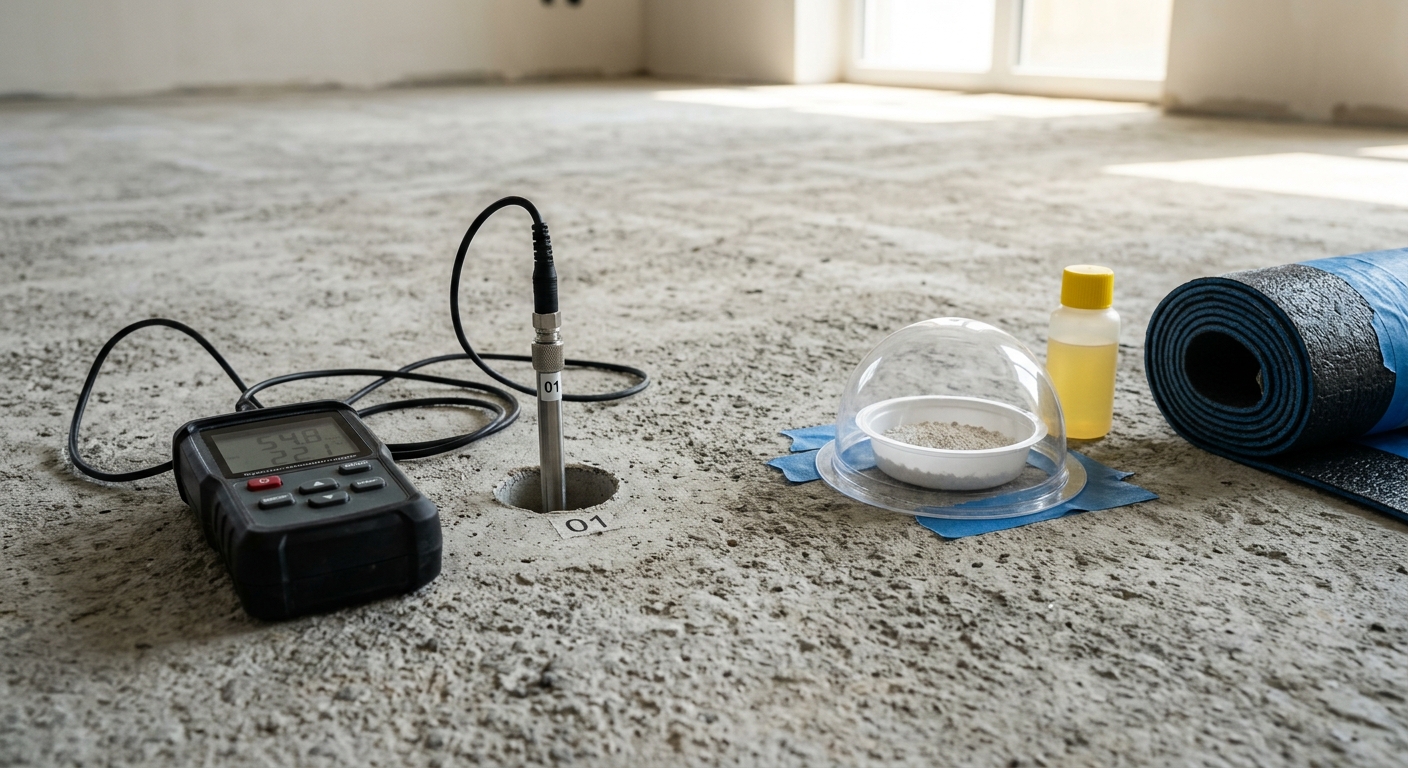
At Big Head Flooring, once a slab passes its moisture test the next question decides just as much: is it flat enough? Flatness is the failure mode nobody warns you about, and it is the second-most-common reason a new floor fails early across the Inland Empire and North San Diego County, right behind moisture. The two problems are cousins, not twins. Moisture is what a slab is giving off. Flatness is what its surface is doing, and a slab can pass one and fail the other. We check both before a board goes down, we tell you the number, and we do the prep it takes to hit spec. No shortcuts.
Moisture is what a slab is giving off. Flatness is what its surface is doing. A slab can pass one test and fail the other, so we run both before anything goes down.
We have pulled up enough floors that felt fine on paper but rocked, ticked, and telegraphed dips within a season to stop treating flatness as optional. It is not the plank that failed. It is the slab the plank was fighting. This is the step the big-box installs skip, and it is why we take the "my new floor feels bouncy" call so often. If your slab already passed its ASTM moisture testing, flatness is the very next thing we read.
How flat does a subfloor need to be for vinyl plank?
Flat within 3/16 inch over any 10-foot span, and 1/8 inch over 6 feet. That 3/16-over-10 tolerance is not our preference, it is the number written into nearly every LVP, laminate, and engineered-wood manufacturer warranty, and installing outside it is what voids coverage. A floating vinyl plank floor bridges anything wider than that gap, loses full contact with the slab, and flexes at every step. We measure the slab against a 10-foot straightedge before we ever open a box.
Here is the part that catches homeowners off guard: thin LVP is less forgiving than the tile or thick hardwood it replaced. A rigid tile field can span a small dip. A 5mm floating plank cannot, so it settles into every low spot and rises over every high one. The thinner and cheaper the plank, the tighter the slab has to be. This is exactly what our flooring preparation and leveling work corrects before install, because prep is the difference between a floor that lays dead-flat and one that ticks under your heel.
What 3/16 inch over 10 feet actually means on your slab
It means over any straight 10-foot line on your floor, the highest point and the lowest point can differ by no more than 3/16 of an inch, about the thickness of three stacked nickels. Over a shorter 6-foot span the window tightens to 1/8 inch. That is a tighter tolerance than most slabs are poured to, especially older or fill-dirt pours, which is why prep is a separate line on almost every honest estimate out here.
"A slab does not have to look uneven to be out of spec. Three nickels of dip across ten feet is invisible to the eye and loud under a plank. The straightedge tells the truth the eye cannot."
We find slabs out of tolerance for three reasons in this region, and each one gets a different fix:
- Trowel ridges and high spots from the original pour. The concrete crew finished it flat enough for a garage, not for a 5mm floating floor. High spots we grind down flush.
- Settled low spots and dips. Nearly every newer home in Temecula, Murrieta, Menifee, and Wildomar is slab-on-grade, and slabs settle unevenly with the soil and the fill under them. Dips we fill with self-leveling underlayment.
- Pier-and-beam subfloor deflection. Older Escondido homes around Grand Avenue and Washington Park run tongue-and-groove subfloor over crawl spaces, a different substrate that dips and flexes between joists rather than at settled slab seams.
Prep is billed separately precisely because we cannot know how far out your slab is until we straightedge it. That is why we never quote a fixed prep cost before we see the floor, and why our quotes stay upfront and honest with no hidden fees once we do.
Self-leveling underlayment depth: how we bring a low slab back into spec
For the dips, we pour self-leveling underlayment, a flowable cement-based compound that seeks its own level and hardens into a flat plane the floor can sit on. We spec it rated to 1/2 inch depth in a single pour, which covers the vast majority of settled low spots we find on slab-on-grade homes. High spots get ground down first with a concrete grinder, because you level down to the low areas and fill up to meet the highs, not just dump compound everywhere.
The sequence matters as much as the material. We grind the highs, fill active cracks with flexible polyurea so they flex with the slab instead of re-cracking through the new floor, prime the slab so the compound bonds, then pour the self-leveler and let it cure before we straightedge it again to confirm we hit 3/16 over 10. Only then does the floor go down. That full grind, fill, and self-level prep is what turns an out-of-spec slab into one a warranty can live on. Ready when you are: call (760) 216-2984 and we will straightedge your slab before you spend a dollar on material.
Why LVP telegraphs every dip you leave behind
Telegraphing is when the shape of the substrate shows through the finished floor, and thin luxury vinyl plank is the worst offender because it is flexible and it is thin. Lay a 5mm floating plank over a slab with a 1/4-inch dip and the plank does not span the gap, it drapes into it. You feel the give underfoot, you hear a tick or a hollow snap as the click joint flexes, and over time that repeated flex works the joints loose until edges lift and gaps open.
"Thin LVP does not hide a bad slab. It reports it. Every dip you skip in prep becomes a soft spot you feel and a joint that eventually fails."
Rigid glue-down LVP and tile are more forgiving of small imperfections because they are fully bonded, but even they fail over real dips: glue-down planks bond to a hollow and eventually crack the adhesive, and tile over a high spot cracks at the peak. The honest read is that flatness is not a plank-quality problem you can buy your way out of. The best plank on the market still needs a slab inside 3/16 over 10, which is exactly why flatness prep comes before the floor we install, not after the callback.
When you do NOT need us to level your slab
We are not going to sell you a self-leveling pour your slab does not call for. If we straightedge your floor and it already sits inside 3/16 inch over 10 feet, comfortably flat, then it does not need leveling and we will tell you that on the spot. You pay for the straightedge check and standard prep, not for a compound pour the slab does not need. A well-finished newer tract slab in Menifee or Murrieta often comes in flat enough on its own, and forcing a leveling pour onto it is money you should keep. Where it earns every dollar: settled slabs, fill-dirt pours near the lake, trowel-ridged garages-turned-living-space, and pier-and-beam floors that dip between joists.
Flatness and moisture are two tests, not one
The reason we run both a straightedge and a moisture test is that they catch different problems and one passing tells you nothing about the other. A bone-dry slab can be badly out of level, and a dead-flat slab can be pushing far too much vapor to floor over. We have straightedged slabs near Lake Elsinore in Tuscany Hills and Rosetta Canyon that read fine for flatness and failed moisture at near 8 pounds MVER, and dry inland slabs that passed moisture clean and needed a full self-leveling pour to hit flatness. You cannot guess either one. You measure both.
That is why our prep line covers the slab as a whole: we test moisture with ASTM F1869 and F2170, we straightedge for the 3/16-over-10 flatness spec, we grind the highs and self-level the lows, and we fill active cracks with flexible polyurea. Do all four and the floor you pay for is the floor you keep. Skip any one and it becomes the callback. Tell us what your floor is doing and we will read the slab the right way before anything goes down.
Frequently asked questions
Why does my floor feel bouncy or uneven?
Almost always because the subfloor underneath it was not flat enough before the floor went down. A floating floor needs the slab inside 3/16 inch over 10 feet, and when it is not, the plank bridges the low spots, loses contact with the substrate, and flexes every time you step on it. That flex is the bounce you feel and the tick or hollow snap you hear, and left alone it works the click joints loose until edges lift. Sometimes it is loose fasteners or a plank that shifted, but on a newer floating floor the usual culprit is a slab that was never leveled to spec. We straightedge the slab to find the dips, grind the highs, and pour self-leveling underlayment where it settled, which is the only real fix for a floor telegraphing an uneven substrate.
What does self-leveling underlayment cost to pour?
It depends entirely on how far out of level your slab is and how much area needs a pour, which is why we never quote a fixed prep price before we straightedge the floor. Self-leveling underlayment rated to 1/2 inch depth covers most settled dips we find on slab-on-grade homes, but a slab that needs grinding on the highs plus a deep fill on the lows costs more than one with a single shallow low spot. We give upfront, honest numbers after we see the slab, with no hidden fees, and prep is billed as its own line so you know exactly what the leveling costs versus the floor itself.
Can you install vinyl plank over an uneven floor?
Not without leveling it first, or the floor fails early. Thin LVP is flexible and telegraphs every dip, so laying it over an uneven slab means soft spots you feel, joints that tick, and edges that eventually lift, and doing so voids the plank's warranty because the manufacturer requires 3/16 inch over 10 feet at install. The right move is to bring the slab into tolerance first: grind the high spots, fill active cracks with flexible polyurea, and pour self-leveling underlayment into the dips. Then the plank sits on a flat plane and lays dead-flat the way it is supposed to. We straightedge and level before we install so you do not find out about a dip after the floor is down.
Do you serve my city?
We serve Escondido, Lake Elsinore, Menifee, Murrieta, Oceanside, Temecula, Vista, and Wildomar across the Inland Empire and North San Diego County. We are licensed and insured, run ASTM moisture testing and a flatness check on every slab, back our work with a two-year labor warranty, and offer free estimates on every project.
Get your slab straightedged before the floor goes down
Do not let a floor you love turn bouncy because nobody checked the slab was flat. Let us straightedge your subfloor, grind the highs, self-level the lows, and hand you a floor that lays dead-flat with the warranty intact. Call (760) 216-2984 for a free estimate, read about our flooring preparation and leveling process, or see how we handle flooring installation start to finish. Installed right the first time, guaranteed.