Installation Guide —
Why We Moisture-Test Every Slab Before Flooring Goes Down (ASTM F1869 / F2170)
The single most-cited reason a new floor fails early out here is not the plank. It is the slab underneath it. Here is why we run ASTM F1869 calcium chloride and F2170 relative humidity tests on every slab before flooring goes down, what a failing reading actually means, and why installing over it voids your warranty.
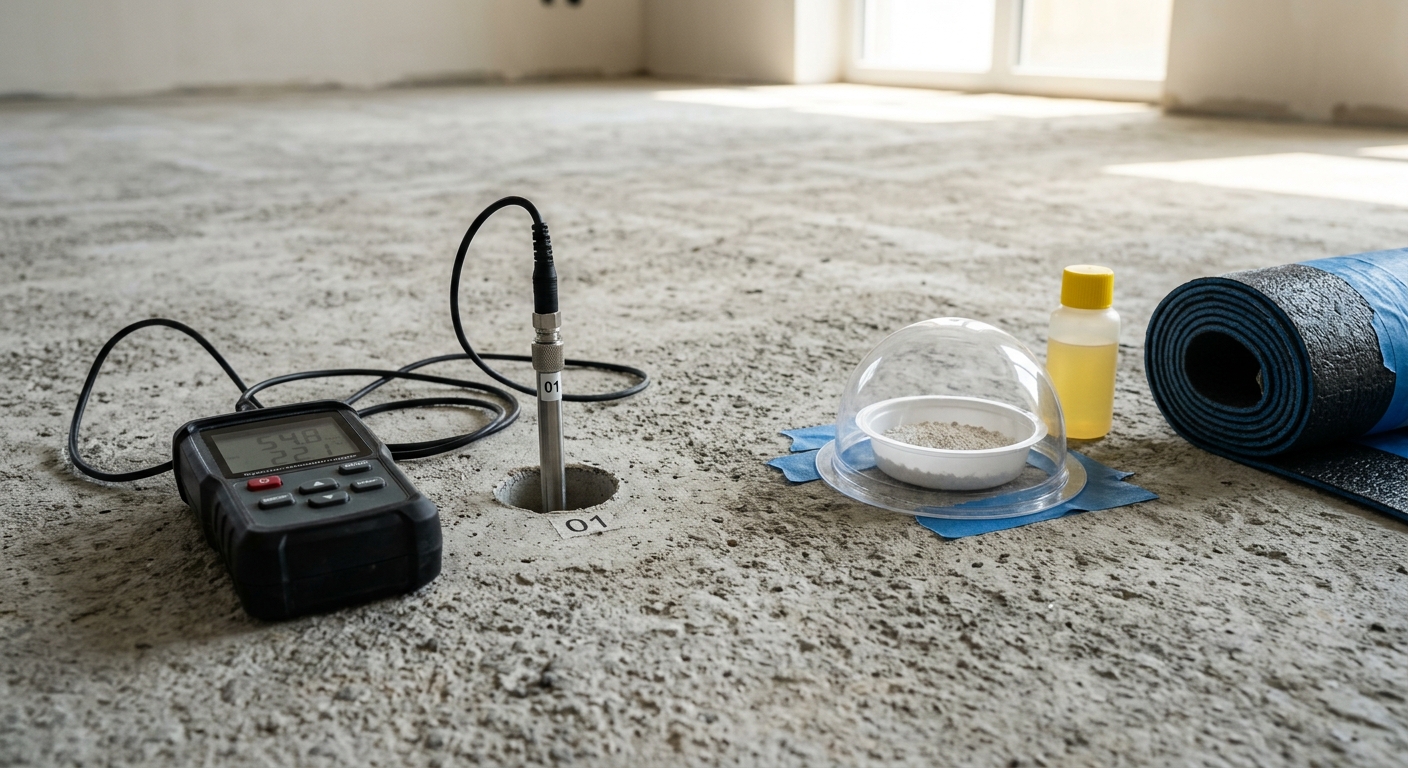
At Big Head Flooring, if we had to name the one failure mode behind more torn-out floors than any other across the Inland Empire and North San Diego County, it would not be a bad plank or a cheap adhesive. It is moisture coming up through a concrete slab that nobody tested. We run ASTM F1869 calcium chloride and ASTM F2170 relative humidity testing on every slab before a single board or tile goes down, and this post explains exactly why. Skip that test and you are gambling your whole floor on a number you never checked. We are licensed and insured, and we would rather hand you a real reading than a callback.
The one failure mode behind more torn-out floors than any other out here is not the plank. It is moisture coming up through a slab nobody tested.
We have pulled up enough cupped hardwood and delaminated LVP across Temecula, Murrieta, Menifee, and the neighborhoods around Lake Elsinore to stop treating the moisture test as optional. Near the lake we have logged calcium chloride results near 8 pounds per 1,000 square feet on slab-on-fill, well past what most floors are rated for. That number is the difference between a floor that lasts and a warranty claim that gets denied. No shortcuts.
Do you need to moisture-test concrete before flooring?
Yes, on every slab, before you pick a material. Concrete looks dry on top and still gives off water vapor from deep in the pour for months or years, and that vapor is what wrecks the bond and the plank. Nearly every newer home out here is slab-on-grade, and the fill-dirt slabs near Lake Elsinore run wetter than most. We test first because the number can rule a material out entirely.
Here is the part that costs homeowners the most: a slab can pass a plastic-sheet "does it look wet" check and still be pushing far too much vapor for a floating floor or a glue-down. The eye test is not a test. The number is the test, and the number is what your flooring manufacturer's warranty is written around. This is the step the big-box installs skip, and it is the reason we take the "my new floor already failed" call so often. Here is how we install over a properly moisture-tested slab, so the floor you pay for is the floor you keep.
ASTM F1869 calcium chloride and F2170 RH: what the two tests actually measure
There are two industry-standard tests, they measure two different things, and we run both because each one catches a problem the other can miss. One reads what is leaving the surface right now. The other reads how wet the slab is deep inside. Together they give you the honest picture instead of half of it.
- ASTM F1869 (calcium chloride, the MVER test). We seal a dish of anhydrous calcium chloride under a dome on the bare slab for 60 to 72 hours. The salt absorbs moisture coming off the surface, and the weight it gains tells us the Moisture Vapor Emission Rate, reported in pounds per 1,000 square feet over 24 hours. Most resilient and wood floors want that number at 3 pounds or under. Near the lake we have seen it near 8.
- ASTM F2170 (relative humidity probe). We drill in-situ probes to 40 percent of the slab's depth, cap them, and let them equilibrate before reading the internal relative humidity. This one matters because a surface can read okay while the core of the slab is still saturated, and that deep moisture drives back to the surface the moment you seal a floor over it. Most manufacturers cap acceptable slab RH around 75 to 85 percent depending on the product.
"We run both tests because the surface can lie. A slab that passes the calcium chloride dish can still read 90 percent RH four inches down, and that is the moisture that cups a floor a season later."
The reason we bother with the deeper, slower F2170 probe rather than just the dish is exactly that mismatch. On slab-on-fill and lakeside pours, the core stays wetter longer, and the RH probe is the only one of the two that sees it. We give you both numbers before you commit to a material, because between them they decide what can safely go down.
What happens if you install flooring over a wet slab
Vapor does not stop pushing just because you covered the slab. It builds under the floor and finds the weakest point in the assembly, and the failure shows up within a season, usually less. This is not a maybe. It is the most predictable failure we see, and every kind of hard floor fails its own way.
- LVP and laminate: Trapped vapor swells laminate's fiberboard core and breaks down the adhesive under glue-down LVP, so planks delaminate, edges lift, and the click joints on a floating floor work loose. You feel it as movement and see it as gaps.
- Engineered and solid hardwood: Wood is hygroscopic. It drinks the vapor and the boards cup, crown, and gap. On a high-MVER slab a hardwood floor can start moving within the first humid stretch after install.
- Tile: More forgiving because it bonds with thinset, but a saturated slab can still debond a membrane or push efflorescence and hollow spots through, especially without the right prep.
The mistake we correct most often: a beautiful floor installed over an untested slab, cupping or lifting within the first season, and a manufacturer warranty that will not pay because nobody documented the moisture number before install.
Here is the trust part nobody at the register mentions: your flooring warranty almost always requires a documented moisture reading within spec at the time of install. Put the floor down over a slab that reads 8 pounds and there is no warranty claim to make, because you skipped the condition the warranty was written around. The moisture test is not just prep. It is the paperwork that keeps your coverage alive.
Mitigation versus a callback: what a failing reading actually costs
When a slab fails the test, the fix is not to give up. It is to mitigate, and mitigation is far cheaper than the alternative. A failing reading means we install a moisture-control system before the floor: a topically applied moisture-vapor barrier or a penetrating densifier-type mitigation rated to hold back the MVER we measured, then the underlayment and floor over it. That is a planned line on the estimate, sized to the reading.
The prep that comes with it matters too. We flatten to the 3/16 inch over 10 feet threshold your plank's warranty requires, fill active cracks with flexible polyurea instead of rigid epoxy that just re-cracks, and pour self-leveling underlayment where the slab dips. That full self-leveling and moisture-barrier prep is what turns a slab that failed a reading into one a floor can safely live on. Ready when you are: call (760) 216-2984 and we will get a real number off your slab before you spend a dollar on material.
The lakeside slabs that taught us to test everything
The reason we test every slab, not just the ones that look suspect, comes straight out of the ground near Lake Elsinore. Lake humidity and fill-dirt slabs in Tuscany Hills, Summerhill, Rosetta Canyon, and Canyon Hills read wetter than the tract slabs a few miles inland, and they do not advertise it on the surface. A slab that looked fine has handed us a calcium chloride result near 8 pounds more than once.
"After enough lakeside jobs, we stopped guessing. A Lake Elsinore slab-on-fill gets tested before we quote a floor, every time, because the ones that fail rarely look any different from the ones that pass."
Inland and coastal slabs have their own profiles too. Slab-on-grade tract homes across Menifee and Murrieta usually read lower, but a west-facing room that bakes across 275-plus sunny days a year drives its own moisture and heat swing. Older Escondido homes around Grand Avenue and Washington Park are pier-and-beam over crawl spaces entirely, a different moisture picture that we read differently. The lakeside slab-moisture mitigation we do around Lake Elsinore is built around exactly these fill-dirt readings.
When you do NOT need us to mitigate a slab
We are not going to sell you a moisture-barrier system you do not need. If your slab tests clean, comfortably under 3 pounds MVER and inside your product's RH spec, and it is flat within 3/16 inch over 10 feet, then it does not need mitigation and we will tell you that on the spot. You pay for the test and the standard prep, not for a barrier the slab does not call for. A well-cured older slab in a dry inland tract home often passes clean, and forcing mitigation onto it is money you should keep.
Where the test and mitigation earn every dollar: any slab-on-fill near the lake, any newer pour that has not fully cured, and any floor where a manufacturer warranty is on the line. Where it is money you do not need to spend: a proven-dry, well-cured slab that reads clean on both tests. Either way, you find out which one you have from the number, not a guess, and the number is cheap.
Frequently asked questions
What is a failing MVER reading?
MVER is the Moisture Vapor Emission Rate from the ASTM F1869 calcium chloride test, reported in pounds per 1,000 square feet over 24 hours. For most LVP, laminate, and wood floors, a reading at or under 3 pounds is the common acceptable limit, though you always check your specific product's spec. Anything meaningfully above that is a failing reading for those floors. Near Lake Elsinore we have logged results near 8 pounds on slab-on-fill, more than double the typical limit, which rules out a bare install and calls for a moisture-mitigation barrier first. We pair the MVER number with an ASTM F2170 relative humidity probe reading, because a slab can pass the surface dish and still be too wet deep inside.
Can you install LVP over a high-moisture slab?
Not directly, and not without failing early. Vapor from a high-MVER slab breaks down the adhesive under glue-down LVP and works the click joints loose on a floating floor, so planks lift, gap, and delaminate within a season, and the warranty will not cover it because the moisture number was out of spec at install. The right move on a high-moisture slab is to install a moisture-vapor mitigation barrier rated to the reading we measured first, then the LVP over it. We test with ASTM F1869 and F2170 before we spec anything, so if your slab reads high we build the barrier into the plan instead of finding out after the floor lifts.
How long does a slab moisture test take?
The ASTM F1869 calcium chloride dish sits sealed on the slab for 60 to 72 hours before we weigh it, and the ASTM F2170 relative humidity probes need time to equilibrate in the drilled holes before we read them. So a proper test is not a same-visit number, it is a short wait that saves you a torn-out floor. We plan it into the front of the job so the reading is in hand before you commit to a material, not discovered after the crew shows up.
Do you serve my city?
We serve Escondido, Lake Elsinore, Menifee, Murrieta, Oceanside, Temecula, Vista, and Wildomar across the Inland Empire and North San Diego County. We are licensed and insured, run ASTM moisture testing on every slab, back our work with a two-year labor warranty, and offer free estimates on every project.
Get a real moisture number off your slab first
Do not let a floor you love fail early because nobody checked the slab underneath it. Let us run ASTM F1869 and F2170, hand you the numbers, and spec mitigation only if the reading calls for it. Call (760) 216-2984 for a free estimate, read about our flooring installation process, or see the self-leveling and moisture-barrier prep that turns a failing slab into one a floor can live on. Installed right the first time, guaranteed.