Commercial & Warehouse Flooring for the Inland Empire and North San Diego County
Big Head Flooring installs commercial and warehouse flooring across the Inland Empire and North San Diego County, spec'd to the traffic your space actually takes: commercial LVT with a 40-mil-plus wear layer, commercial-grade porcelain, and polished or epoxy-coated concrete for shop and warehouse bays. We moisture-test every slab with ASTM F1869 calcium chloride and F2170 relative humidity probes, run our own crew on every job, and schedule installs after hours so your business keeps running.
You run an office, a shop, a brewery, or a warehouse bay, and the floor is failing or was never rated for the traffic it takes. Residential-grade product wears out fast in a commercial space, and downtime while it gets replaced costs you real money. We build around that: we spec to the actual traffic, test the slab first, and schedule around your operating hours so the work does not shut you down. Licensed and insured, 5-star rated, own crew on every job, and a free on-site walk-through with a written quote before anything starts.
Warehouse Floors: Polished and Epoxy-Coated Concrete Built for Traffic
Warehouse and shop bays need a floor that hoses clean and takes forklift and pallet-jack traffic without denting. For those spaces we point clients toward polished or epoxy-coated concrete, not planks. It bonds to the slab, resists staining from oil and chemicals, and holds up under rolling load where residential-grade product would dent and telegraph wear within a season.
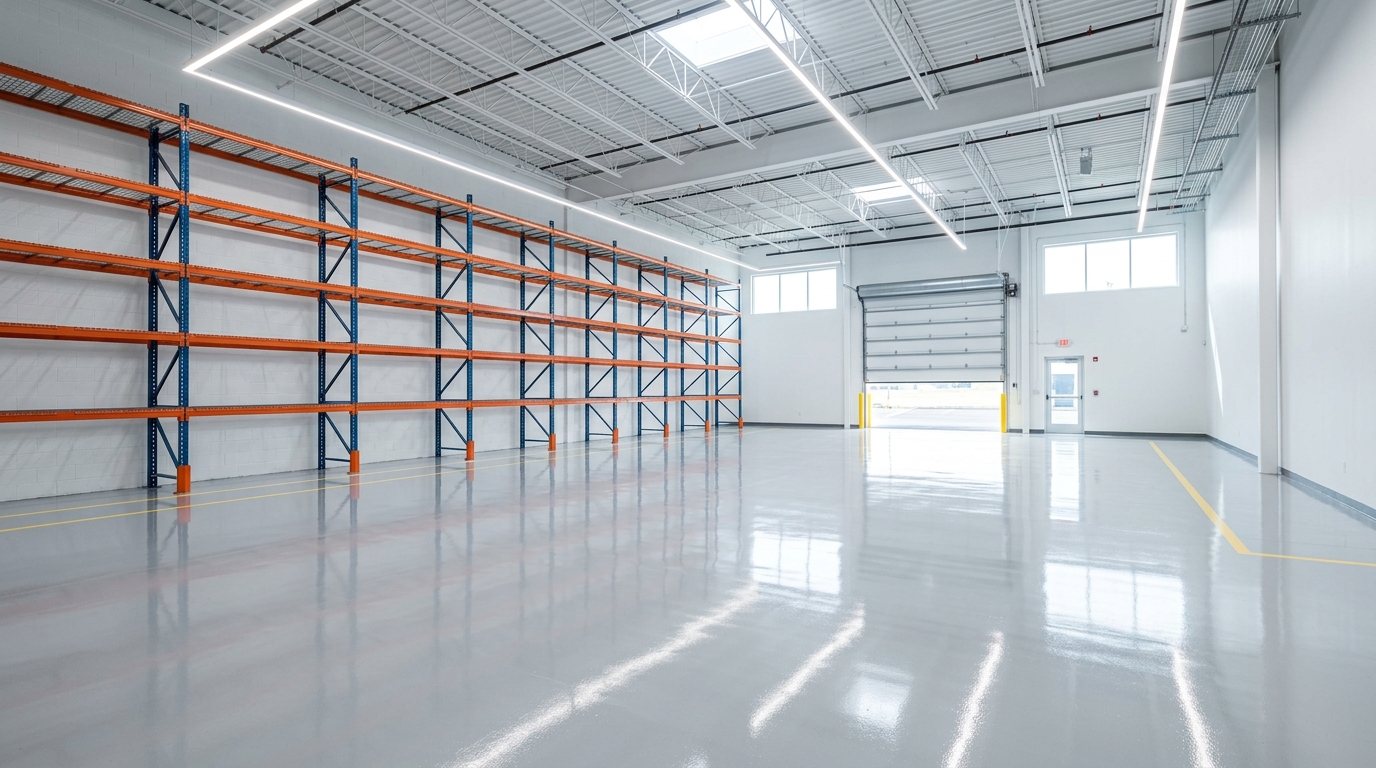
The prep is the job on a warehouse slab. Here is how a warehouse or shop-bay floor runs from walk-through to open bay:
- Slab assessment and moisture testing. We run ASTM F1869 calcium chloride and F2170 RH probe tests before we quote a coating. A warehouse slab poured decades ago can read high MVER and blow out an adhesive or coating bond in a season if it is not addressed first.
- Grind to profile. We grind the slab to the correct concrete surface profile so the coating mechanically bonds. A coating over a slick, un-profiled slab peels.
- Crack and joint repair. Cracks get flexible polyurea filler, not rigid epoxy that re-cracks as the slab moves. Control joints are addressed so the coating does not fail at the seams.
- Moisture-mitigating base coat where readings require it. On high-MVER slabs we lay a moisture-mitigating base coat before color and topcoat. That base coat is why our coatings stay stuck when a big-box weekend kit peels.
- Color and topcoat. The finish coat goes down last, cured to the manufacturer's schedule before traffic returns.
A warehouse slab poured decades ago can read high MVER and blow out a coating bond in a season. We test first, then coat. That order is the whole difference.
Ready to spec a warehouse or shop-bay floor? Request a free on-site walk-through and we will test the slab and quote the coating to your traffic.
Mechanical Room Flooring and Utility Spaces
Mechanical rooms, utility closets, storage bays, and back-of-house spaces take abuse that finished areas never see: standing water risk, dropped tools, wheeled equipment, and chemical exposure. Epoxy-coated concrete is usually the right call here for the same reasons it wins in a warehouse. It cleans easily, does not absorb staining, and takes a beating.
For mechanical and utility spaces we weigh two paths depending on how the room is used:
- Epoxy-coated or polished concrete for equipment rooms, storage, and any space that needs to hose clean or handle chemical and oil contact
- Commercial-grade LVT with a 40-mil-plus wear layer for back-of-house spaces that stay dry and see foot traffic more than rolling load
We will not spec the same product for a mechanical room that we would use in a front office. Every space gets evaluated on its actual use, moisture exposure, and traffic type. On any slab that reads high moisture, remediation comes before the floor goes down, not after it fails.
Talk to us about your utility spaces at the walk-through. Call (760) 216-2984, Monday through Saturday, 8 AM to 6 PM.
What We Install in Commercial Spaces
Different commercial spaces call for different floors. Residential-grade product fails fast in a commercial setting, so we spec to the traffic and the use. Here is what goes where:
Commercial LVT, 40-mil wear layer minimum
For offices, showrooms, and retail with pedestrian traffic. Commercial-rated luxury vinyl tile holds up where a residential wear layer would scuff and dent under constant foot traffic. The 40-mil-plus wear layer is the spec that separates a floor that lasts from one that looks tired in a year. This is the same waterproof luxury vinyl technology we install residentially, rated up a class for commercial load.
Commercial-grade porcelain
Where wet-area durability and appearance both matter: restrooms, entries, food-service floors, and high-visibility retail. For restaurant and brewery installs we use epoxy grout, slip-resistant tile rated to DCOF 0.42 or higher, and proper floor drains with waterproof membrane transitions. Those details keep you in compliance with health department requirements and cut slip-and-fall liability. Our tile crew does this work in-house, no subcontracted setters.
Polished or epoxy-coated concrete
For warehouse, shop, and storage bays that need to take rolling load and hose clean. Bonded to a properly profiled slab, it outlasts any plank product in a high-abuse space.
Coastal-grade transitions where the salt air demands it
In coastal spaces near Oceanside and Vista, salt air corrodes cheap transitions in a warehouse the same way it does in a condo. We spec stainless or aluminum transitions, never zinc-plated, on coastal commercial jobs.
Most commercial LVT and porcelain we install is fully waterproof at the core, which matters in food service, breweries, and any space with a wash-down routine. See our breakdown of waterproof flooring options for where a waterproof core earns its keep.
Why Businesses Choose Big Head Flooring for Commercial Work
Two things separate a commercial flooring job that works from one that costs you twice: how the slab is handled, and how the schedule respects your operation.
We moisture-test every commercial slab, no exceptions. We run ASTM F1869 calcium chloride and F2170 RH probe tests on commercial slabs the same way we test residential. A slab that reads high MVER will blow out an adhesive bond or lift a coating within a season, and the failure always shows up after the floor is down and the space is back in use. Testing first is cheaper than tearing out a failed floor and closing the space a second time.
We work around your hours. Downtime is a direct cost in commercial work. We schedule installs after hours and on weekends, phase the work room by room, and stage materials so your functioning areas stay accessible. Tell us your operating window at the walk-through and we build the schedule around it.
We use our own crew. No subcontracting. The people who start your job finish it, and the workmanship is backed by a two-year labor warranty covering installation-related defects. We are licensed and insured with full liability coverage.
When commercial flooring is not the right call yet
We will tell you when you do not need us. If your existing commercial floor is under a few years old, still bonded, and the only issue is a few scuffed or lifted planks in a walkway, a targeted floor repair is almost always cheaper than a full replacement. If a coated warehouse slab is peeling only in one bay because of a moisture spot, that is a spot fix, not a tear-out. And if your slab has never been moisture-tested and you have no symptoms yet, get the test before you spend on any floor at all. We would rather quote the right scope than the biggest one.
Ready to talk? Get a free commercial quote and we will walk the space, test the slab, and spec the floor to your traffic.
Commercial & Industrial Flooring in Escondido
Escondido is the older-slab city in our service area, and that changes the commercial spec. The building stock around Grand Avenue and the Valley Parkway corridor mixes decades of construction, so a shop bay or office floor here often sits on a slab poured long before anyone was thinking about moisture testing. That is exactly the slab that reads high MVER and blows out an adhesive bond or lifts a coating in a season if it is not handled first.
Escondido detail: commercial permits and inspections here run through San Diego County and the City of Escondido building department, not Riverside County. We pull to the correct AHJ for your address.
We run ASTM F1869 calcium chloride and F2170 relative humidity probes on every Escondido commercial slab before we quote a floor. For offices, showrooms, and retail along the Grand Avenue corridor, that usually means commercial LVT with a 40-mil-plus wear layer over an adhesive system spec'd to the reading. For shop and warehouse bays, it means polished or epoxy-coated concrete over a properly profiled slab, with a moisture-mitigating primer where the numbers call for it. On the oldest mixed-stock buildings we check for prior coatings and mastic before we grind, because a decades-old slab rarely comes clean on the first pass.
Residential and commercial under one crew
We handle residential and light-commercial work across the city, and the commercial slab gets the same slab-first treatment. See flooring throughout Escondido for the full local picture. Call (760) 216-2984 to book a free on-site walk-through.
Commercial & Industrial Flooring in Menifee
Menifee's business parks are newer Riverside County construction, which flips the slab problem: instead of decades-old concrete, we are often testing green slabs that have not finished curing. A newer slab can still read high relative humidity for months after it is poured, and a coating or adhesive laid over a green slab fails the same way an old-slab job does. We run ASTM F1869 and F2170 testing on Menifee commercial slabs for exactly that reason, then spec commercial LVT with a 40-mil-plus wear layer, commercial porcelain, or epoxy-coated concrete to the reading and the traffic.
"A new slab is not a dry slab. In Menifee's newer business parks we test the RH before we coat, because a green slab lifts a coating just as fast as an old one."
Because Menifee is a growing commercial market for us, we built a dedicated page that covers the local spec, the business-park slab detail, and the scheduling in full. For the deep-dive, see our dedicated Menifee commercial flooring page, or flooring throughout Menifee for residential and light-commercial work. Call (760) 216-2984 to confirm we cover your address.
Industrial & Commercial Flooring in Lake Elsinore
Lake Elsinore is the moisture-mitigation city. Slabs near the lake sit on fill dirt and take elevated MVER readings that we have seen hit 8 lbs per 1,000 square feet on calcium chloride, high enough to lift any coating or adhesive that goes down without remediation first. A commercial or industrial floor here lives or dies on how the moisture is handled, not on the finish product.
Lake Elsinore reading: lakeside fill-dirt slabs have tested at 8 lbs / 1,000 sq ft on calcium chloride. On a slab that high, a moisture-mitigating primer under the coating is the whole job, not an upsell.
So the sequence on a Lake Elsinore shop, warehouse, or industrial bay is moisture first, floor second. We run ASTM F1869 calcium chloride and F2170 RH probes, and where the numbers require it we lay a moisture-mitigating primer under epoxy-coated concrete before any color or topcoat goes down. That primer is why our coatings stay bonded on a lakeside slab where a big-box weekend kit peels off in sheets by the end of summer. For dry back-of-house spaces we still spec commercial LVT with a 40-mil-plus wear layer, but the epoxy-coated concrete over a mitigated slab is what wins in the high-abuse, high-moisture bays here.
Permits and local coverage
Commercial permits in Lake Elsinore run through Riverside County and the City of Lake Elsinore building department. Because the lakeside slab is its own problem, we built a dedicated page on the local spec. See our Lake Elsinore commercial flooring service for the deep dive, or flooring throughout Lake Elsinore for residential and light-commercial work. Call (760) 216-2984 to book a free on-site walk-through and slab test.
Commercial Flooring Across the Inland Empire and North San Diego County
Light-commercial demand runs across the whole region, and we serve it under one crew. In North San Diego County, the corridor along Oceanside Boulevard and the industrial blocks off Airport Road run offices, showrooms, breweries, and warehouse space, and we install warehouse and light-commercial floors in Oceanside built for that traffic. For the coastal salt-air spec and the local scheduling detail, see our Oceanside commercial flooring service. Vista has a healthy small-business corridor along Vista Village Drive and South Santa Fe Avenue, where we handle light-commercial flooring for Vista businesses including offices, retail shops, breweries, and restaurants.
The slab is what changes city to city
Inland, we cover commercial and light-commercial work in Escondido, Murrieta, Menifee, Lake Elsinore, Temecula, and Wildomar. The slab is what changes city to city: older mixed stock in Escondido, newer green business-park slabs in Menifee, and high-MVER lakeside slabs in Lake Elsinore each get a different spec, which is why we cover those three in the dedicated sections above. Murrieta, Temecula, and Wildomar we evaluate the same way, each space on its own conditions.
Whichever city you are in, the fundamentals do not change: we moisture-test the slab, we spec to the traffic, and we schedule around your hours.
This is commercial and light-commercial flooring installation done the way it should be. Call (760) 216-2984 to confirm we cover your address and to book a free on-site walk-through.