Buying Guide —
Does Salt Air Damage Hardwood Floors? What Actually Holds Up in Coastal Oceanside
Salt air itself does not rot a hardwood floor overnight. What actually wears coastal hardwood in Oceanside and beach-side Vista is the marine humidity swing behind it, plus the corrosion it drives at the metal parts. Here is the spec that holds up.
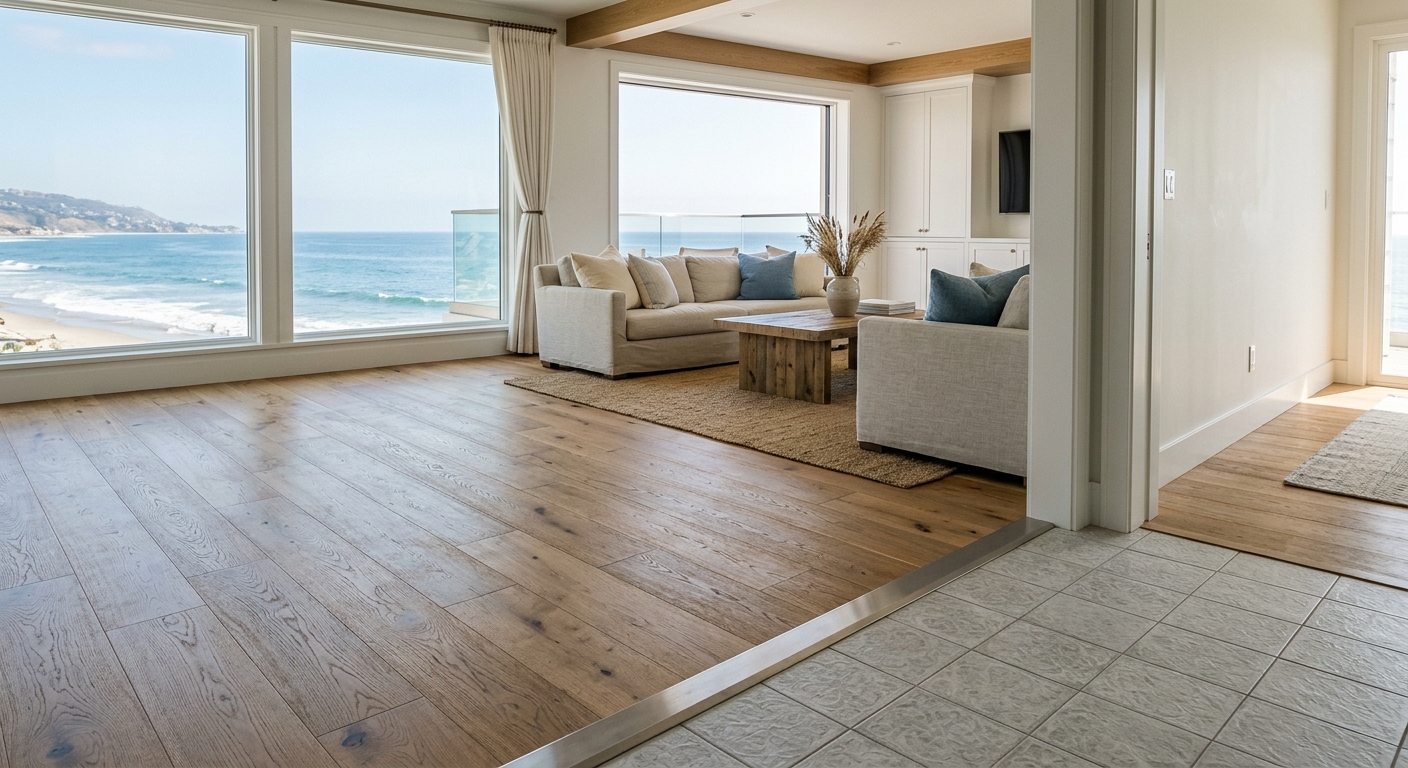
At Big Head Flooring, the coastal version of the hardwood question comes up on nearly every job we quote near the water in Oceanside and beach-side Vista: does salt air ruin a wood floor? The honest answer is that salt air is not the direct killer people picture. It does not eat the finish off your planks in a season. What wears coastal hardwood is the marine humidity that rides in with that salt air, swinging the moisture in the wood back and forth, plus the corrosion the salt drives at every metal part touching the floor. Spec around those two things and hardwood holds up beautifully a block from the sand. Ignore them and you are refinishing in five years.
Salt air is not the direct killer people picture. It is the marine humidity behind it, swinging moisture in the wood, plus the corrosion the salt drives at every metal part.
We are licensed and insured, we run ASTM moisture testing on every slab, and we have pulled up enough coastal floors to know exactly which specs survive a beach-proximate home and which ones fail. This guide walks the same coastal spec we bring to a job on the west side of the 5 in Oceanside, so you know what to ask for before anyone quotes you. No shortcuts.
Does salt air damage hardwood floors?
Not directly, and not fast. Salt air does not chemically attack a wood plank the way it corrodes bare metal. The real damage runs through two paths. First, marine humidity near the coast stays higher and swings more than it does inland, and wood is hygroscopic, meaning it absorbs and releases moisture with the air around it. That constant swing makes solid wood expand and contract, which opens gaps in winter and cups or crowns boards in humid stretches. Second, the salt that rides in with that air corrodes the zinc-plated fasteners, transition strips, and thresholds a standard install uses, and once those rust they stain and loosen the floor from the edges in.
The mistake we correct most often near the water: a beautiful solid-oak floor installed to inland specs, with cheap zinc transition strips already rust-streaked at the doorways within two summers.
So the question is not really "does salt air hurt hardwood." It is "did anyone spec the floor for a coastal moisture and corrosion load, or did they install it like it was in Menifee." Those are two different floors. The finished planks can look identical on day one.
Best hardwood flooring for coastal homes: engineered over solid
For a home near the water, engineered hardwood is the call over solid, and it is not close. Engineered planks are built from a real hardwood wear layer bonded over a cross-laminated plywood or HDF core. Those cross-grain layers fight the expansion and contraction that marine humidity drives, so the floor stays dimensionally stable through the moisture swing that would gap or cup a solid plank. You still get a genuine wood surface you can sand and refinish, without the seasonal movement.
Here is how we spec a coastal hardwood floor, top to bottom:
- Engineered construction, not solid. A quality engineered plank with a thick sawn wear layer refinishes like solid wood but holds its shape through the humidity swing.
- UV-stabilized, factory-cured finish. Coastal light is bright and reflective, and a UV-stabilized aluminum-oxide finish resists the fading and dulling that unsealed or site-finished wood shows first near the water. This is the same intense-light problem we spec around inland, where 275-plus sunny days a year fade an unprotected floor.
- Stainless or anodized aluminum transitions. Every threshold, T-molding, and reducer that would normally be zinc-plated gets swapped for stainless steel or anodized aluminum so salt cannot rust it.
- A moisture and flatness check first. The slab still has to pass before any of this goes down.
If you want the local, project-level version of this, here is our page on hardwood flooring installation in Oceanside, which covers the coastal specs on an actual job.
Engineered vs solid hardwood near the ocean: the head-to-head
A straight comparison makes the coastal case obvious. Both are real wood on top. What separates them near the water is what happens underneath when the air gets humid.
- Dimensional stability. Solid wood is one species all the way through and moves as a single piece with humidity, so it gaps and cups more in a marine swing. Engineered planks are cross-laminated to resist that movement. Near the water, that is the whole ballgame.
- Refinishing life. Solid wood can be sanded many times. A quality engineered plank with a thick sawn wear layer can typically take two or three sandings, which is plenty for a residential floor's lifetime. You are not giving up refinishing to get stability, and when a coastal floor is only surface-worn, knowing whether to refinish or replace it comes down to how much of that wear layer is left.
- Install method. Solid strip usually wants a nail-down over a wood subfloor. Most coastal homes here are slab-on-grade, where engineered goes down as a glue-down or floating install that suits the slab better.
- Cost over the life of the floor. Solid can cost less per plank, but a solid floor that cups and needs re-sanding in a humid coastal home costs more per year than an engineered floor that just stays flat.
"Solid oak is a gorgeous floor in a dry inland bedroom. A block from the beach, engineered is the floor that still looks flat and tight after five winters of marine humidity."
The one place solid still makes sense on the coast is an older raised-foundation home with a well-ventilated crawl space and a wood subfloor, where a nail-down solid floor over the right vapor control can work. Most beach-side homes here are slab, and on a slab the engineered answer is clear.
The slab and humidity control that make it last
The floor is only as good as what is under it and the air around it. Nearly every newer coastal home out here is slab-on-grade, and a slab holds and passes moisture you cannot see. Before a single plank goes down, we run ASTM F1869 calcium chloride and ASTM F2170 relative humidity testing on the slab and confirm it meets the 3/16 inch over 10 feet flatness threshold your plank's warranty requires. A high moisture reading can force a mitigation step or rule a glue-down out entirely, and we would rather tell you that before you buy material.
Acclimation is the step the big-box installs skip, and near the water it matters twice as much. The planks have to reach the home's true relative humidity before they are locked in place, or they finish moving after they are down. We also talk with coastal clients about keeping indoor humidity in a stable range, because a floor spec'd right and then run through a wide swing is being asked to do the impossible. Ready when you are: call (760) 216-2984 and we will get a real moisture read off your slab before you spend a dollar on material.
When hardwood is NOT the right call near the water
We are not going to talk you into a hardwood floor a coastal room should not have. If you are flooring a beach-house entry off a sandy deck, a bathroom, a laundry room, or any space that sees standing water and wet feet all summer, hardwood is the wrong material there, engineered or not. Wood is still wood, and a room that stays wet wants tile with a proper waterproof membrane or an SPC-core vinyl plank that does not care about moisture. Put the hardwood in the living areas, bedrooms, and halls where it belongs, and use a moisture-proof surface in the wet zones.
Where coastal hardwood is worth every dollar: the main living spaces of a beach-proximate home where you want real wood underfoot and are willing to spec engineered construction, stainless transitions, and a UV-stabilized finish to earn it. Where it is a false economy: a wet entry, bath, or laundry, or a solid-wood floor installed to inland specs and left to swing with the marine humidity. If that is the room you are asking about, we will tell you straight.
Frequently asked questions
How do I protect wood floors from humidity in a coastal home?
Start with the right material and finish the job with stable indoor air. Spec engineered hardwood, not solid, so the cross-laminated core resists the expansion and contraction that marine humidity drives. Acclimate the planks in the actual home for several days before install so they reach the room's true relative humidity, and confirm the slab passes ASTM F1869 and F2170 moisture testing and the 3/16 inch over 10 feet flatness check first. Then keep indoor humidity in a stable range rather than letting it swing wide. Those steps together are what keep a coastal floor flat and tight.
Does salt air rust the hardware in a wood floor?
Yes, and that is one of the two real coastal problems. Standard zinc-plated fasteners, thresholds, and transition strips corrode in salt air, rust-streak the floor at the doorways, and loosen the planks from the edges in. On coastal jobs we spec stainless steel or anodized aluminum transitions and appropriate fasteners so salt cannot rust the metal parts that hold your floor together.
Is engineered hardwood really as good as solid near the ocean?
For a beach-proximate slab home, engineered is the better floor, not a compromise. A quality engineered plank has a real hardwood wear layer you can sand and refinish, and the cross-laminated core holds its shape through the marine humidity swing that would cup or gap a solid plank. Solid wood still shines in a dry raised-foundation home with a wood subfloor, but on the coastal slabs we see most, engineered is the call.
Do you serve my city?
We serve Escondido, Lake Elsinore, Menifee, Murrieta, Oceanside, Temecula, Vista, and Wildomar across the Inland Empire and North San Diego County. For the coastal specifics, here are our flooring services in Oceanside. We are licensed and insured, back our work with a two-year labor warranty, and offer free estimates on every project.
Get a coastal-grade hardwood floor spec'd right
Do not let a beautiful hardwood floor fail early because it was installed to inland specs a block from the sand. Let us get a moisture reading off your slab, spec engineered construction with stainless transitions and a UV-stabilized finish, and acclimate the wood to your home before it goes down. Call (760) 216-2984 for a free estimate, or read about our hardwood flooring installation in Oceanside. Installed right the first time, guaranteed.