Buying Guide —
Epoxy and Garage Floor Coatings for Inland Empire Homes and Shops
A bare garage slab is the last raw floor in most Inland Empire homes, and the coating that goes on it lives or dies on one thing almost nobody tests first: what the slab is doing underneath. Here is how we match epoxy, polished concrete, or a coated system to your garage or shop, and why the moisture test comes before the color chip.
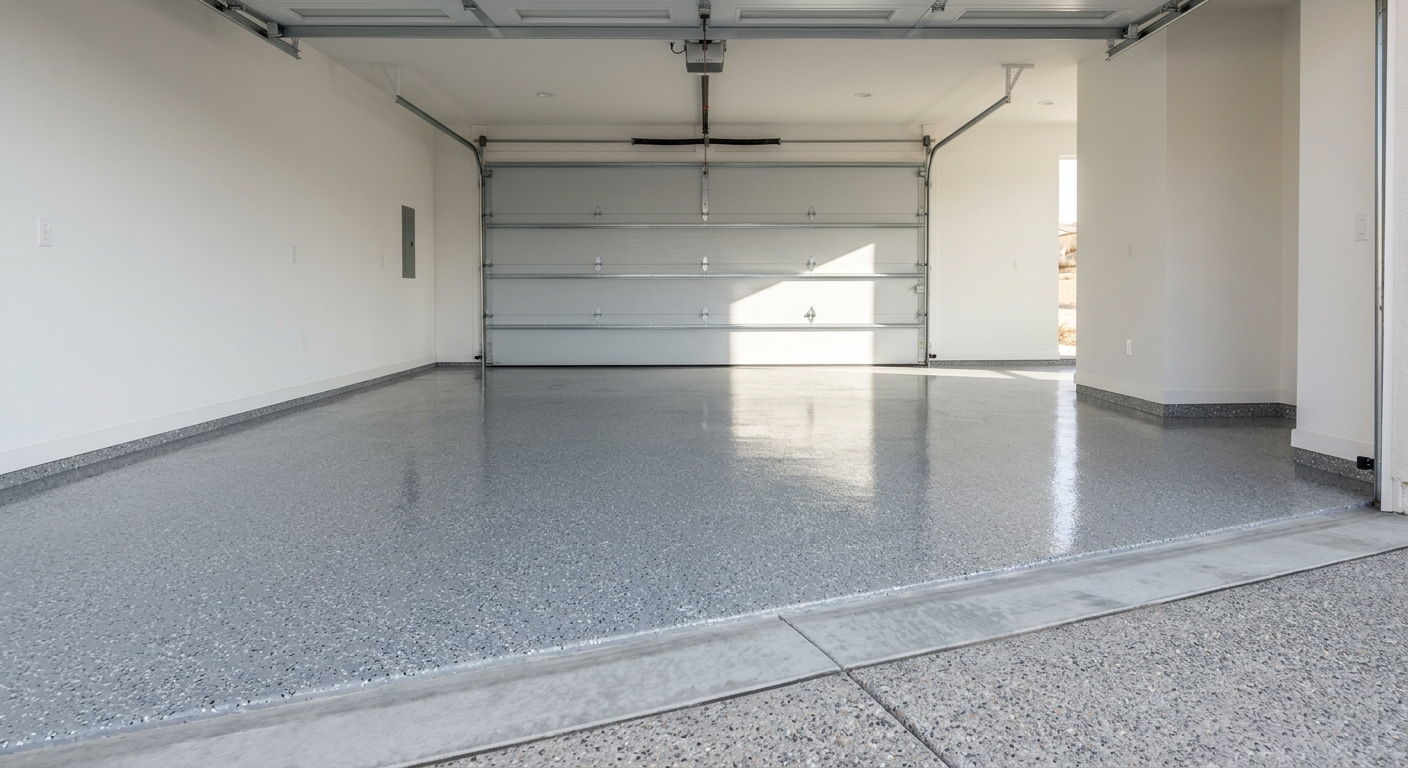
At Big Head Flooring, the garage floor is the job homeowners in Menifee, Lake Elsinore, and Temecula put off the longest and then rush at the end. You have a bare, dusting, oil-stained slab, you have seen the glossy flake floors online, and you want one. The honest thing we tell every caller before we talk color chips: a garage coating is only as good as the slab it bonds to, and the slab out here is almost never ready without a look first. Get the prep and the moisture read right and an epoxy or polished-concrete floor lasts for decades in a hot-dry garage. Skip it and the coating peels off in sheets within a year.
A garage coating is only as good as the slab it bonds to. The color chip is the last decision, not the first.
We are licensed and insured, we run ASTM moisture testing on every slab we coat, and we will tell you straight when a full epoxy system is worth it and when a simpler floor makes more sense for how you actually use the space. No shortcuts. This guide walks the same decision we run in your garage, shop bay, or light-commercial space, so you know what to ask for before anyone quotes you.
Epoxy flooring in Lake Elsinore: why the slab decides everything here
In Lake Elsinore, a garage or shop coating starts with a moisture number, not a product pick. Coatings bond directly to the concrete, and lakeside humidity plus fill-dirt slabs around Tuscany Hills, Rosetta Canyon, and Canyon Hills push vapor up through that bond. We have logged calcium chloride results as high as 8 pounds per 1,000 square feet on slab-on-fill near the lake, well past what any coating is rated to sit on.
Lake Elsinore fact: Slab-on-fill near the water reads higher for moisture than slab-on-grade a few miles inland. A garage epoxy that would hold fine in Menifee can delaminate on the same-looking slab in Terra Cotta or Alberhill if nobody tested it first.
That is the failure we get called to fix most: a flake floor that looked perfect for a summer, then bubbled and peeled once the slab's vapor drive had nowhere to go but up under the coating. The coating did not fail. The install skipped the test. This is why we treat the moisture read as the gate, not a formality, and why we will not quote a Lake Elsinore garage coating off a phone call. We need a real number off your slab first. If you want the local, project-level version of how we handle it here, see our page on flooring in Lake Elsinore. Ready when you are: call (760) 216-2984 and we will get a moisture read before you spend a dollar on a coating.
Garage flooring in Menifee: what a new-build slab actually needs
In Menifee, most garages sit on young slab-on-grade concrete in newer tract and builder-upgrade homes, and a fresh slab brings its own catch: new concrete holds construction moisture longer than people expect, and a coating rushed onto a slab that has not dried down traps that vapor. With 275-plus sunny days a year and a closed-up garage that bakes all summer, the surface looks bone dry while the slab is still curing underneath.
Here is what we check on a Menifee garage before any coating goes down:
- ASTM F1869 calcium chloride and ASTM F2170 relative humidity testing on the slab, so we know the real vapor number, not the surface feel.
- Flatness against the 3/16 inch over 10 feet threshold, because a coating telegraphs every dip and high spot the way tile does.
- Cracks and control joints, filled with flexible polyurea crack filler that moves with the slab instead of rigid epoxy that just re-cracks at the joint.
- Surface profile, the concrete has to be mechanically ground or shot-blasted to open the pores so the coating grabs, not just cleaned.
"A builder-grade garage slab looks ready the day you get the keys. The moisture number says otherwise more often than not, and that is the whole reason we test before we coat."
That grinding and prep step is where the cheap quotes cut corners, and it is exactly why they peel. If you are in a new-build community and weighing a garage floor as part of your upgrade list, here is our page for flooring in Menifee with the local specifics. The prep is not the part to save money on. It is the part that decides whether the floor lasts.
Epoxy vs polished concrete garage floor: which one fits your garage
The two most common coated-slab floors are not the same product, and the right one depends on how you use the space, not which one looks better in a photo. Epoxy is a coating you build on top of the concrete. Polished concrete is the slab itself, ground and densified to a finish. Both start with the same moisture test and the same prep, then they diverge.
The short version: epoxy (usually a coating plus a UV-stable polyaspartic or polyurethane topcoat) gives you color, flake, and a fully sealed surface. Polished concrete gives you a hard, low-maintenance floor with no coating to peel, but less color choice. Traffic and looks decide it.
Here is how we sort the two for a garage, shop, or light-commercial bay:
- Epoxy with a polyaspartic or polyurethane topcoat is the call for most home garages that want the finished, showroom look: full color, decorative flake, a seamless sealed surface that wipes clean of oil and brake dust. The topcoat matters in our climate, straight epoxy without a UV-stable topcoat can amber and chalk in a west-facing garage that takes intense sun. We spec the topcoat as part of the system, not an add-on.
- Polished concrete is the call for a working shop or a high-traffic bay where you want the toughest, lowest-maintenance floor and do not care about color. There is no coating layer to peel or hot-tire-pickup off, because the finish is the slab. It handles rolling load and point impact that would eventually mar a thinner coating.
- A mixed approach fits a lot of real garages: polished or a heavy-build coating in the working bay, a decorative flake epoxy in the finished side. We rate the space by use, not by one product for the whole footprint.
When neither one is the right call yet
We are not going to talk you into a coating your garage is not ready for. Do not coat a slab that has active moisture failing the ASTM test until the number comes down, because the best coating on earth peels off a wet slab. Do not coat a slab with wide, moving cracks that have not been addressed first. And if your garage is a short-term rental turn or a space you are about to remodel, a full flake system may be more floor than the job needs. In those cases we will say so rather than sell you the biggest scope. A coating belongs on a sound, dry, prepped slab, and not before.
Garage and shop coatings scale up to light-commercial
The same framework that picks your home-garage floor scales straight into a shop or light-commercial bay. Sort the space by traffic, then let the traffic pick the floor: rolling and impact zones under jacks and heavy carts get a heavy-build coating or polished concrete, foot-traffic zones like a parts counter or office can take a thinner system, and every one of them still starts with the moisture test. That is the same approach we bring to commercial and warehouse floor coating systems across the region, just sized to a single garage or a two-bay shop instead of a full building.
The difference between a home garage and a shop bay is the traffic class, not the fundamentals. Test the slab, prep it right, match the system to the load.
For a light-commercial space that gets both wet and walked, there is a third path worth knowing about: DCOF-rated porcelain tile in the wet zones instead of a coating. It is a different conversation from the epoxy-versus-concrete split, but it belongs in the same plan when part of the floor sees standing water.
Frequently asked questions
Do you install garage floor tile, or only coatings?
We do both, and which one fits depends on the space. For a standard home garage or shop, an epoxy or polished-concrete coated slab is usually the better value because it bonds to the concrete as a seamless, oil-resistant surface with no grout lines to trap dirt. Interlocking or adhered garage floor tile has its place in a dry, lower-traffic garage where you want a removable floor, but under hot-tire pickup and rolling load a coated slab typically outlasts it. Either way, we test the slab for moisture and check flatness first, because both a coating and a tile floor fail from underneath if the slab is pushing vapor up through the bond. We will walk your garage and tell you honestly which one your space and budget call for.
Does an epoxy floor coating need moisture testing first?
Yes, and it is not optional. Epoxy and polished-concrete coatings bond directly to the concrete, so a slab pushing moisture up through that bond will lift, bubble, and peel the coating within a season, and the failure never shows until the floor is already down. We run ASTM F1869 calcium chloride and ASTM F2170 relative humidity testing on the slab before we coat anything, because the surface can feel bone dry while the slab is still driving vapor. Near Lake Elsinore we have logged readings as high as 8 pounds per 1,000 square feet on slab-on-fill, well past coating tolerances. If the number comes back high, mitigation comes first, and a coating over a tested, sound slab is a fraction of the cost of a tear-out and re-coat.
Will epoxy hold up in a hot Inland Empire garage?
It holds up well when the system is specced for the climate. A closed garage in Menifee or Temecula builds real heat across 275-plus sunny days a year, and straight epoxy without a UV-stable topcoat can amber and chalk in a west-facing bay. That is why we build the system with a polyaspartic or polyurethane topcoat over the epoxy, which keeps the color stable and adds abrasion and hot-tire resistance. Prepped right on a moisture-tested slab, a coated garage floor lasts for decades out here.
Do you serve my city?
We serve Escondido, Lake Elsinore, Menifee, Murrieta, Oceanside, Temecula, Vista, and Wildomar across the Inland Empire and North San Diego County. We are licensed and insured, run ASTM moisture testing on every slab, back our work with a two-year labor warranty, and offer free estimates on every project.
Get your garage floor matched to your slab and your traffic
Stop shopping for the shiniest floor and start with what your slab is actually doing. Let us test the concrete for moisture, check the flatness, and spec epoxy, polished concrete, or a coated system to how you use the space, in one honest quote. Call (760) 216-2984 for a free on-site walk-through, read about commercial and warehouse floor coating systems, or see our pages for flooring in Lake Elsinore and flooring in Menifee. Installed right the first time, guaranteed.