Buying Guide —
Commercial LVT vs Epoxy-Coated Concrete: Which Warehouse Floor Holds Up
The commercial-floor question is not really LVT versus epoxy concrete. It is what your space actually does to the floor: pedestrian traffic in an office, or rolling load and hose-down cleaning in a shop bay. Here is how we split it, plus the slab-moisture test that rules both out if you skip it.
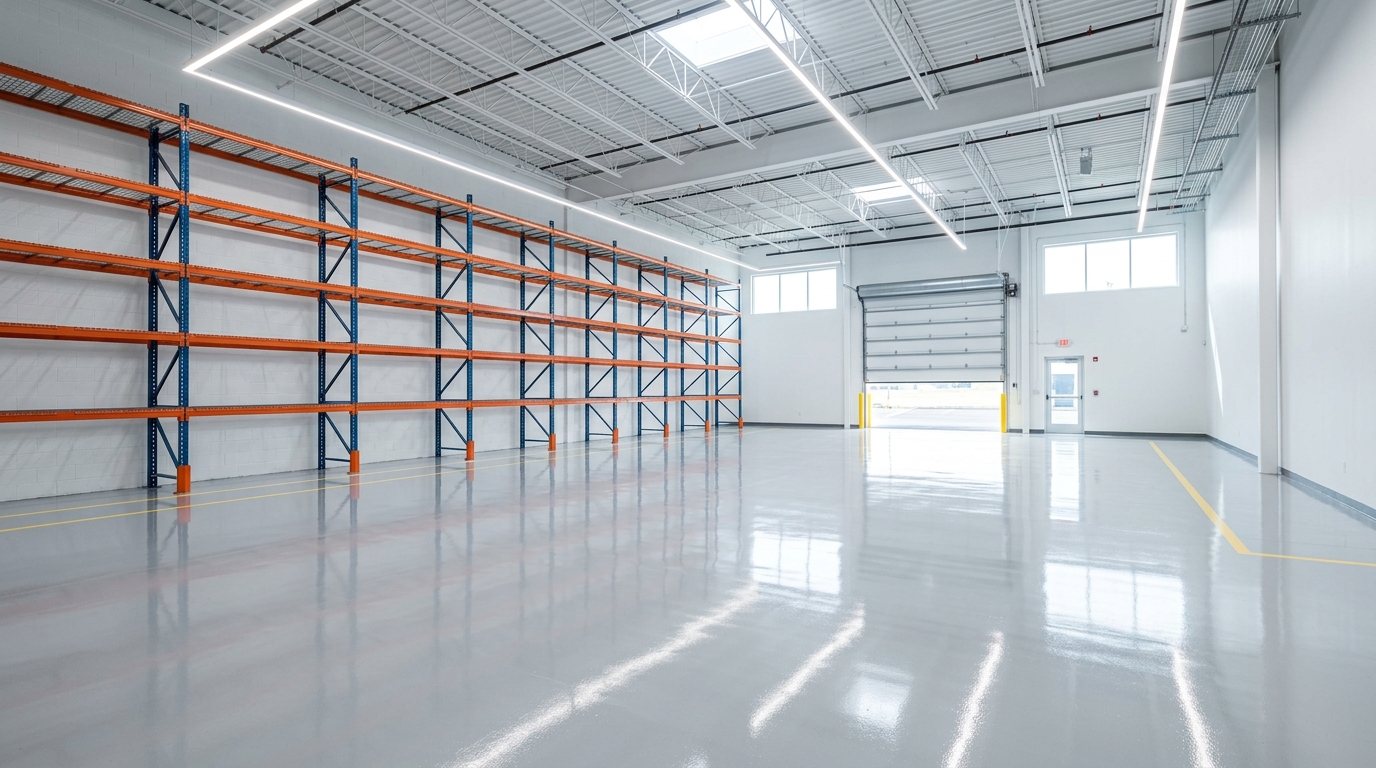
At Big Head Flooring, the commercial version of the flooring question stalls almost every business owner we meet, whether it is a Temecula office suite, a Murrieta shop, or a warehouse bay off the Oceanside Boulevard corridor. It usually comes out as "should I do commercial LVT or epoxy concrete?" That framing skips the part that actually decides it. The right floor is set by what the space does to the floor, not by which product sounds tougher. An office and a wash-down shop bay are two different jobs, and the answer changes bay to bay inside the same building.
The right floor is set by what the space does to the floor, not by which product sounds tougher. An office and a wash-down shop bay are two different jobs.
We are licensed and insured, we run ASTM moisture testing on every slab, and we will tell you when commercial LVT is the smart call and when a shop bay needs a coated slab instead. We handle commercial and warehouse flooring installation across the region with our own crew, no subcontracted setters. No shortcuts. This guide walks the same split we run on-site.
Commercial LVT vs epoxy concrete: how we actually split the decision
The split comes down to one question we ask first: does this space take pedestrian traffic, or does it take rolling load and wash-down cleaning? That single answer sorts most of a commercial building. Offices, showrooms, and retail are foot-traffic spaces, and commercial-rated LVT with a 40-mil-plus wear layer is built for them. Warehouse, shop, and storage bays take pallet jacks, forklifts, dropped tools, and hose-down cleaning, and that is polished or epoxy-coated concrete territory. Mixing them up is how a floor fails inside a season.
The fast rule: pedestrian traffic points to commercial LVT (40-mil-plus wear layer). Rolling load and hose-down cleaning point to polished or epoxy-coated concrete. Most commercial buildings need both, zoned by how each area is used.
Here is how we sort a typical commercial or mixed-use space:
- Commercial LVT, 40-mil wear layer minimum: offices, showrooms, retail, and dry back-of-house areas that see foot traffic more than rolling load. The 40-mil-plus wear layer is the spec that separates a floor that lasts from one that looks tired in a year. It is the same waterproof luxury vinyl technology we install residentially, rated up a class for commercial load.
- Polished or epoxy-coated concrete: warehouse, shop, and storage bays that take rolling load and need to hose clean. Bonded to a properly profiled slab, it outlasts any plank product in a high-abuse space.
- Commercial-grade porcelain: restrooms, entries, and food-service floors where wet-area durability and appearance both matter. That is a different conversation, but worth knowing it exists as the third path.
The mistake we correct most often in commercial work: someone puts commercial LVT in a shop bay because it was cheaper to install, then a pallet jack and a monthly hose-down peel it off the slab inside a year.
What is the best floor for a warehouse bay?
For a true warehouse or shop bay, the best floor is almost always polished or epoxy-coated concrete bonded to a properly profiled, moisture-tested slab, not a plank product. Warehouse bays take three loads a plank floor is not built to survive: rolling load from pallet jacks and forklifts, point impact from dropped tools and equipment, and wash-down cleaning where water and chemicals sit on the floor. A coated slab shrugs off all three. It cleans easily, does not absorb staining, and takes a beating that would lift and gouge LVT.
"A warehouse floor is not decor, it is a work surface. We spec the coated slab to the traffic and the cleaning routine, then bond it to a slab that has passed moisture testing, because a coating over a wet slab peels no matter how good the product is."
There is one honest exception. A back-of-house space that stays dry and sees foot traffic more than rolling load, a parts counter, a dry storage room, a break area, is fine on commercial LVT. That is why we walk the space bay by bay instead of speccing one product for the whole building. Coastal spaces add a wrinkle: near Oceanside and Vista, salt air corrodes cheap transitions in a warehouse the same way it does in a beachfront condo, so we spec stainless or aluminum transitions, never zinc-plated, on coastal commercial jobs. If your space is on the coast, our Oceanside commercial flooring page covers the salt-air specifics.
Ready when you are: call (760) 216-2984 and we will walk your bays and spec each one to its actual use.
The gate that comes before either floor: slab moisture testing
Before you choose between LVT and a coated slab, you need to know what your slab is doing, because moisture rules both of them out if it reads high. This is the step that gets skipped, and it is the difference between a floor that lasts and a floor you tear out and pay for twice. A slab that reads high MVER will blow out an LVT adhesive bond or lift a concrete coating within a season, and the failure always shows up after the floor is down and the space is back in use.
Why testing is not optional: both commercial LVT and epoxy coatings bond to the slab. A slab pushing high moisture pushes vapor up through that bond and delaminates the floor from underneath. You cannot see it before install. You can only test for it.
We run ASTM F1869 calcium chloride and ASTM F2170 relative humidity probe tests on commercial slabs the same way we test residential, and we confirm the slab meets the flatness spec the floor requires before anything goes down. If the number comes back high, remediation comes first, not after the floor fails. This is exactly why slab moisture testing and prep come before any commercial floor on our jobs. Testing a slab costs a fraction of tearing out a failed floor and closing the space a second time.
Downtime is a cost: how we schedule commercial work
For a business, the floor is only half the job. The other half is not shutting you down while we install it. Downtime is a direct cost in commercial work, so we schedule installs after hours and on weekends, phase the work bay by bay, and stage materials so your functioning areas stay accessible. Tell us your operating window at the walk-through and we build the schedule around it.
"We plan the sequence around your hours, not ours. A phased, room-by-room schedule keeps you open while the floor goes in, which is worth more to most owners than shaving a day off the timeline."
That scheduling is also why we use our own crew and do not subcontract. The people who start your job finish it, and the workmanship carries a two-year labor warranty covering installation-related defects. Tell us about your space and we will build the scope and the schedule together.
When you do not need a full commercial floor yet
We are not going to talk you into a tear-out you do not need. If your existing commercial floor is under a few years old, still bonded, and the only issue is a few scuffed or lifted planks in a walkway, a targeted repair is almost always cheaper than a full replacement. If a coated warehouse slab is peeling in one bay because of a single moisture spot, that is a spot fix, not a whole-floor job. And if your slab has never been moisture-tested and you have no symptoms yet, get the test before you spend on any floor at all.
Where a full commercial floor is genuinely the right call: a space that has outgrown residential-grade product that keeps failing, a warehouse bay with no proper coated slab under constant rolling load, or any mixed-use building where the floor was never zoned to the traffic in the first place. In those cases the right floor, spec'd to the use and bonded to a tested slab, is the cheaper number over the life of the space. We would rather quote the right scope than the biggest one.
Frequently asked questions
Does a warehouse slab need moisture testing before a new floor?
Yes, every time, and it is the step we will not skip. Both commercial LVT and epoxy or polished concrete coatings bond directly to the slab, and a slab reading high moisture will delaminate either one from underneath within a season. We run ASTM F1869 calcium chloride and ASTM F2170 relative humidity probe tests on the slab before we spec a floor, and if the reading comes back high, moisture remediation happens before the floor goes down, not after it fails. The failure from an untested slab always surfaces after the space is back in use, which means a second tear-out and a second shutdown. Testing first is a fraction of that cost.
What commercial wear layer mil rating do I actually need?
For commercial LVT in offices, showrooms, and retail, we spec a 40-mil-plus wear layer as the minimum. That mil rating is the thickness of the clear protective layer over the printed film, and it is the single spec that separates a floor that holds up under constant foot traffic from one that scuffs and dents inside a year. Residential LVT typically runs a thinner wear layer that is fine at home but fails fast in a commercial setting. If a space sees rolling load or wash-down cleaning rather than foot traffic, no wear layer on a plank product is the right answer, that space wants polished or epoxy-coated concrete instead. On a high-moisture slab that gate matters even more: on the lakeside fill-dirt lots in Lake Elsinore we have tested at 8 lbs MVER, so a coating goes down over a moisture-mitigating primer or it peels, which is the whole reason we built a dedicated page on commercial flooring for Lake Elsinore warehouses.
Can I use commercial LVT in a warehouse to save money?
Only in the dry, foot-traffic parts of it. Commercial LVT with a 40-mil-plus wear layer is a solid, cost-effective floor for offices, parts counters, dry storage, and break areas. But in an active warehouse or shop bay that takes pallet-jack and forklift traffic, dropped tools, and hose-down cleaning, LVT lifts and gouges, and the money you saved on install you spend twice on the tear-out. For those bays, polished or epoxy-coated concrete bonded to a tested slab is the floor that actually lasts. We walk the space bay by bay and spec each zone to its real use.
Do you serve my city?
We serve Escondido, Lake Elsinore, Menifee, Murrieta, Oceanside, Temecula, Vista, and Wildomar across the Inland Empire and North San Diego County. We are licensed and insured, run ASTM moisture testing on every slab, back our work with a two-year labor warranty, and offer free estimates on every project.
Get the right commercial floor spec'd to your space
Stop guessing between LVT and a coated slab. Let us walk your space, test the slab, and spec each area to its actual traffic in one honest quote. Call (760) 216-2984 for a free on-site walk-through, read about our commercial and warehouse flooring installation, or see how slab moisture testing and prep come first on every job. Installed right the first time, guaranteed.