Buying Guide —
How to Choose Commercial Flooring by Traffic Rating: Epoxy Concrete, LVT, or Porcelain
The best commercial floor is the one matched to what actually rolls, walks, and spills on it. Here is the three-class framework we use to sort a building by traffic rating: coated concrete for rolling load, 40-mil-plus LVT for foot traffic, and DCOF 0.42 porcelain for wet zones.
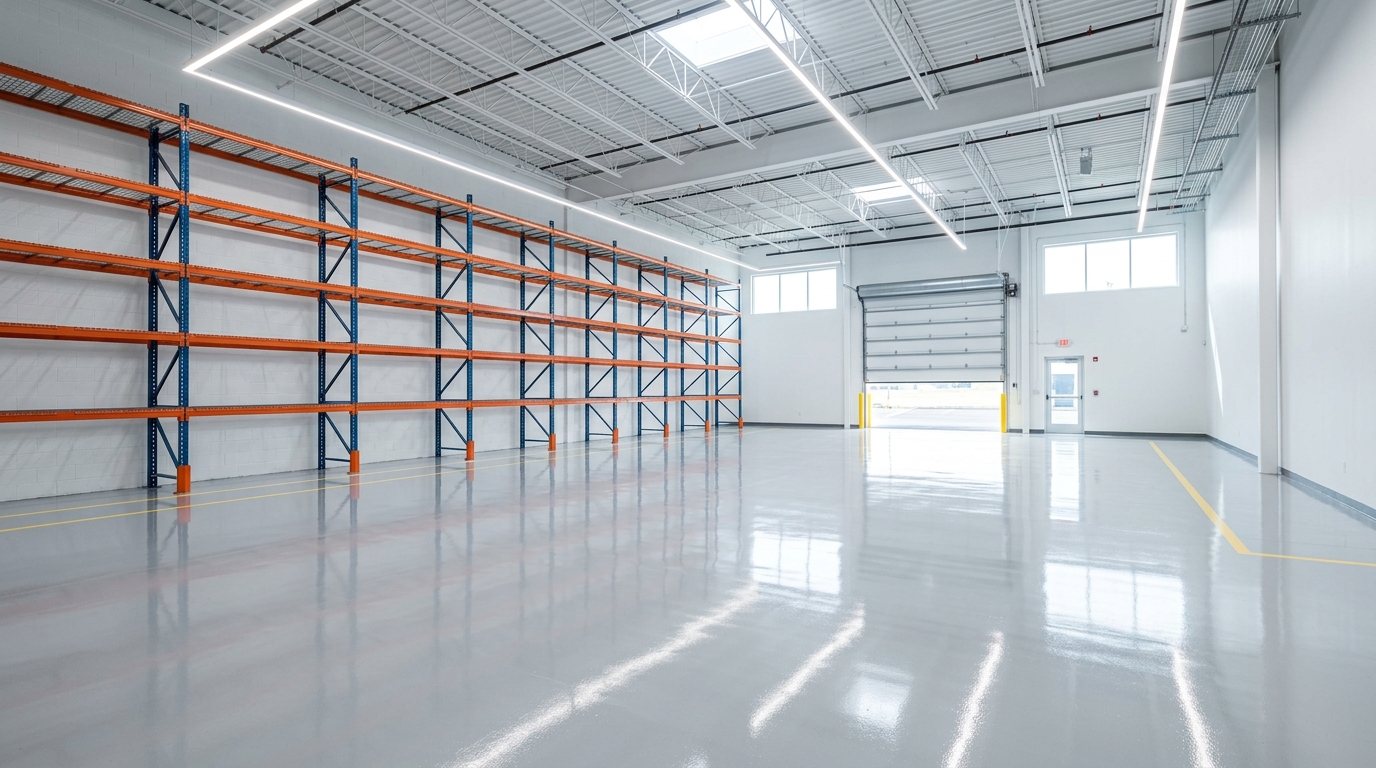
At Big Head Flooring, most commercial owners come to us asking which flooring product is toughest. That is the wrong question, and it is why so many commercial floors fail early. The floor does not fail because the product was weak. It fails because nobody matched the floor to what the space actually does. A forklift bay, a retail showroom, and a food-prep line put three completely different loads on the slab, and no single product wins all three. So we do not pick a product first. We rate the traffic first, then the product answers itself.
We do not pick a product first. We rate the traffic first, then the product answers itself. Match the floor to the load and it lasts. Guess at the product and you tear it out.
We are licensed and insured, we run ASTM moisture testing on every slab, and we handle commercial and warehouse flooring across the Inland Empire with our own crew, no subcontracted setters. This guide is the exact three-class framework we walk on-site, from the Temecula office corridor to a shop bay off Oceanside Boulevard. No shortcuts.
How to choose the best flooring for high traffic commercial areas
The best flooring for high-traffic commercial areas is decided by the type of traffic, not the amount of it. A busy office and a busy warehouse are both high-traffic, but one takes shoes and the other takes forklifts, and those want opposite floors. So before we talk product, we sort every zone in a building into one of three traffic classes. That single sort answers most of the flooring plan.
The three-class rule: rolling and impact load (forklifts, pallet jacks, dropped tools) points to coated or polished concrete. Pedestrian load (offices, retail, showrooms) points to 40-mil-plus commercial LVT. Wet and slip-critical load (food service, restrooms, entries) points to DCOF 0.42-plus porcelain with epoxy grout.
Here is what a commercial flooring traffic rating actually sorts into, class by class:
- Rolling and impact zones. Warehouse bays, shop floors, loading areas, and storage under pallet jacks and forklifts. These take point impact and rolling weight a plank floor cannot survive.
- Pedestrian zones. Offices, showrooms, retail floors, corridors, and dry back-of-house. Constant foot traffic, rolling chairs, cart wheels, but no forklifts and no standing water.
- Wet and slip-critical zones. Kitchens, food-prep lines, restrooms, entries, and any floor that gets hosed, mopped wet, or tracks water in from outside. Here slip resistance matters as much as durability.
Most commercial buildings have all three. That is the point of zoning the floor instead of speccing one product wall to wall. We walk the space, rate each zone, and spec each one to its class.
Rolling and impact zones: epoxy concrete vs commercial LVT in a warehouse
For a warehouse bay under rolling load, the answer is polished or epoxy-coated concrete bonded to a profiled, moisture-tested slab, not a plank product. This is the epoxy-concrete-vs-commercial-LVT-warehouse question owners ask most, and the honest split is that they are not competing for the same space. LVT belongs in the dry office up front. The bay with the forklift belongs to the coated slab.
"A warehouse floor is a work surface, not decor. A pallet jack and a monthly hose-down will peel commercial LVT off a slab inside a year. A bonded coated slab shrugs off all of it."
A warehouse bay hits a floor with three loads a plank was never built for:
- Rolling load from pallet jacks and forklifts that concentrates weight on small wheels and shears a plank floor loose at the seams.
- Point impact from dropped tools, equipment, and staged freight that gouges and cracks anything but a bonded slab.
- Wash-down cleaning where water and cleaning chemicals sit on the floor and creep under any adhesive bond.
Coated or polished concrete cleans easily, does not absorb staining, and takes the beating. The one honest exception is a dry back-of-house zone, a parts counter, a dry storage room, a break area, that sees foot traffic more than rolling load. That zone is fine on commercial LVT, which is exactly why we walk the building bay by bay instead of speccing one floor for the whole footprint. Ready when you are: call (760) 216-2984 and we will rate each of your bays on-site.
Pedestrian zones: why 40-mil-plus commercial LVT is the spec
For offices, showrooms, and retail, commercial-rated LVT with a 40-mil-plus wear layer is the floor, and the wear-layer number is the whole spec. The wear layer is the clear protective coat over the printed film, and it is the single line that separates a floor that still looks sharp in year five from one that scuffs and dents inside twelve months. Residential LVT runs a thinner wear layer that is fine at home and fails fast under commercial foot traffic.
Spec floor: 40-mil (roughly 1.0 mm) wear layer minimum for offices and retail. Step it up further for heavy retail or a lobby that sees cart and luggage wheels. It is the same waterproof luxury-vinyl technology we install residentially, rated up a class for commercial load.
The reason we like LVT for pedestrian zones is that it does the job a coated slab cannot: it is quieter underfoot, warmer, and it hides substrate imperfection better while still being genuinely waterproof against the coffee spills and mop water an office floor sees. It goes down fast, and it is easy to swap a damaged plank in a walkway without redoing the room. That said, a lobby or corridor that also takes wet foot traffic off the street may push into the wet-zone class below at the entry, and we zone the entry mat and threshold accordingly. Tell us about your space and we will spec the wear layer to your actual footfall.
Wet and slip-critical zones: DCOF 0.42-plus porcelain with epoxy grout
For a food-service line, a commercial kitchen, a restroom, or a wet entry, the floor is slip-rated porcelain tile, and the number that matters is DCOF. In these zones durability is only half the job. The other half is not putting an employee or a customer on the floor. That is a liability question, not just a wear question, and it is why we spec to a published slip number instead of a look.
"In a wet zone we spec the tile to its DCOF rating first and its appearance second. A gorgeous polished porcelain that goes slick the moment it gets wet is the wrong floor for a kitchen, full stop."
Here is the wet-zone spec we hold to:
- DCOF 0.42 or higher. Dynamic Coefficient of Friction, measured to the ANSI A326.3 standard, is the industry benchmark for a floor expected to get wet. We spec porcelain rated at 0.42 or above for food service, restrooms, and wet entries, because below that the floor is not built for standing water.
- Epoxy grout, not cementitious, in the wet zone. Epoxy grout resists the grease, acids, and constant washing a food-service floor throws at it and will not stain or break down the way standard grout does.
- Full back-butter coverage with modified thinset. We back-butter every tile for full contact so there are no hollow voids under a floor that takes rolling cart load and hose-down cleaning.
- A waterproof approach at any curbed or sloped drain area, built and tested before the tile goes down.
Commercial-grade porcelain is the third path most owners forget exists, and it is the right call anywhere the floor is both wet and walked. It is a different conversation from the LVT-versus-concrete split, but it belongs in the same plan.
The gate that comes before all three: slab moisture testing
Before any of these three floors goes down, the slab has to pass moisture testing, because a wet slab rules out all three. Commercial LVT bonds to the slab with adhesive. Epoxy and polished-concrete coatings bond to the slab directly. Porcelain sets in thinset on the slab. Every one of them fails from underneath if the slab is pushing vapor up through the bond, and the failure never shows until the floor is down and the space is back in use.
Why testing is not optional: a slab reading high MVER will blow out an LVT adhesive bond, lift a concrete coating, or delaminate tile within a season. You cannot see it before install. You can only test for it, and remediation is a fraction of a second tear-out.
We run ASTM F1869 calcium chloride and ASTM F2170 relative humidity probe tests on commercial slabs the same way we test residential, and we confirm the slab meets the flatness spec the floor requires before anything goes down. If the number comes back high, remediation comes first, not after the floor fails. This is exactly why slab moisture testing and prep come before any commercial floor on our jobs.
Coastal commercial spaces add one more spec
Near the water, the traffic class still decides the floor, but salt air adds a metal problem on top of it. Salt corrodes cheap zinc-plated transitions, thresholds, and reducers in a warehouse the same way it does in a beachfront condo, so on coastal commercial jobs we spec stainless steel or anodized aluminum transitions, never zinc-plated. The floor field follows the same three-class framework. The edges just get an upgrade. If your space is on the coast, our coastal commercial flooring in Oceanside page covers the salt-air specifics on an actual job.
When you do not need a full commercial floor yet
We are not going to talk you into a tear-out you do not need. If your existing commercial floor is under a few years old, still bonded, and the only issue is a few scuffed or lifted planks in one walkway, that is a spot fix, not a whole-floor job, and we will tell you so. If a coated warehouse slab is peeling in one bay because of a single moisture spot, we fix the spot, we do not sell you the building. And if your slab has never been moisture-tested and you have no symptoms yet, get the test before you spend a dollar on any floor.
Where a full commercial floor is genuinely the right call: a space where residential-grade product keeps failing under commercial load, a warehouse bay running forklifts over an uncoated slab, or a mixed-use building where the floor was never zoned to the traffic in the first place. In those cases the right floor, matched to each zone's traffic class and bonded to a tested slab, is the cheaper number over the life of the space. We would rather quote the right scope than the biggest one.
Frequently asked questions
What DCOF do I need for slip-resistant flooring in a restaurant?
For a restaurant kitchen, food-prep line, or any wet commercial floor, spec porcelain tile with a DCOF (Dynamic Coefficient of Friction) of 0.42 or higher, measured to the ANSI A326.3 standard. 0.42 is the industry benchmark for floors expected to get wet, and anything below it is not built for a floor that gets hosed, mopped wet, or takes tracked-in water. We also spec epoxy grout in those zones so the grease and acids of a kitchen do not break the grout down, and we back-butter every tile for full contact under rolling cart load. Slip rating comes first in a wet zone, appearance second.
Should a warehouse bay get commercial LVT or epoxy concrete?
For an active warehouse or shop bay under pallet-jack and forklift traffic, polished or epoxy-coated concrete bonded to a moisture-tested slab is the floor, not LVT. A plank product lifts and gouges under rolling load, point impact, and hose-down cleaning, and the money saved on the cheaper install gets spent twice on the tear-out. Commercial LVT with a 40-mil-plus wear layer is the right call only for the dry, foot-traffic parts of the same building, parts counters, dry storage, break areas, and offices. That is why we rate each bay separately instead of speccing one product for the whole footprint.
How do I match commercial flooring to a traffic rating?
Sort every zone into one of three traffic classes, then let the class pick the product. Rolling and impact zones (warehouse and shop bays under forklifts and pallet jacks) get polished or epoxy-coated concrete. Pedestrian zones (offices, retail, showrooms) get commercial LVT with a 40-mil-plus wear layer. Wet and slip-critical zones (kitchens, restrooms, entries) get DCOF 0.42-plus porcelain with epoxy grout. Most buildings need all three, zoned by use. And every one of them starts with an ASTM moisture test on the slab, because a wet slab fails all three.
Do you serve my city?
We serve Escondido, Lake Elsinore, Menifee, Murrieta, Oceanside, Temecula, Vista, and Wildomar across the Inland Empire and North San Diego County. We are licensed and insured, run ASTM moisture testing on every slab, back our work with a two-year labor warranty, and offer free estimates on every project.
Get your commercial floor matched to its traffic
Stop shopping for the toughest product and start matching the floor to the space. Let us walk your building, rate each zone by traffic, test the slab, and spec coated concrete, 40-mil LVT, or DCOF-rated porcelain where each one belongs, in one honest quote. Call (760) 216-2984 for a free on-site walk-through, read about commercial and warehouse flooring across the Inland Empire, or see our coastal commercial flooring in Oceanside. Installed right the first time, guaranteed.