Buying Guide —
Laminate vs Vinyl Plank Flooring: What Actually Holds Up in the Inland Empire
Most laminate-vs-vinyl comparisons skip the one fact that decides it in Southern California: laminate's core swells with moisture, while SPC-core vinyl plank stays stable to 130 degrees subfloor temp. Here is how we steer the choice room by room.
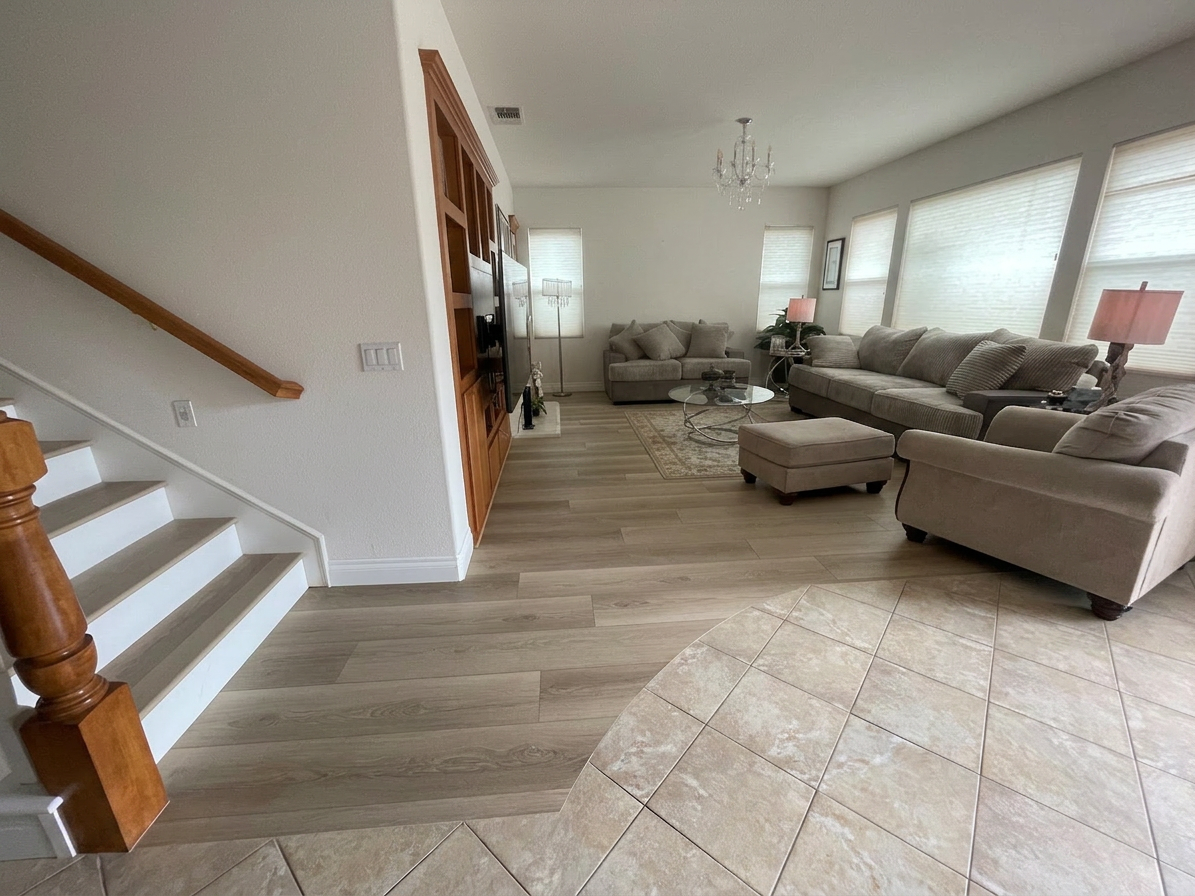
At Big Head Flooring, the laminate-versus-vinyl question is the one that stalls most homeowners we meet in Temecula, Murrieta, and Oceanside. Here is the short version we give before we ever pull out a sample box: the deciding factor is not looks or even price. It is what the core of the plank does when it meets moisture and heat. Get that wrong and you are replacing the floor in five years instead of fifteen.
The deciding factor is not looks or even price. It is what the core of the plank does when it meets moisture and heat.
We have pulled up enough failed installs across the Inland Empire and North San Diego County to have a firm opinion. We are licensed and insured, we run ASTM moisture testing on every slab, and we will tell you when laminate is the cheaper, smarter call and when it is a mistake we would never let you make. No shortcuts.
Laminate vs vinyl plank flooring: the core difference that decides it
Laminate and vinyl plank look almost identical on a showroom floor, but their cores are built from opposite materials, and that is the whole ballgame. Laminate is a high-density fiberboard (HDF) core, basically compressed wood fiber, with a printed image layer and a wear coat on top. Vinyl plank is a plastic-based core with a printed film and wear layer. Wood fiber swells when it gets wet. Plastic does not.
That single fact drives every other decision:
- Moisture: HDF laminate cores absorb water at the seams and edges, then swell, peak, and never lay flat again. Quality SPC (stone polymer composite) vinyl plank shrugs off standing water for hours.
- Heat: A closed-up house in Menifee in August builds serious subfloor heat in west-facing rooms across 275-plus sunny days a year. SPC-core vinyl is dimensionally stable up to roughly 130 degrees subfloor temp. Laminate is more sensitive to that swing at the joints.
- Feel and sound: Laminate over a good underlayment can feel and sound slightly more like real wood underfoot. Vinyl is softer and quieter, which matters for upstairs units under HOA IIC 50 sound ratings.
- Repairs: A damaged laminate plank in the middle of a floating run is a pain to swap. Glue-down vinyl plank can be cut out and patched.
The mistake we correct most often: someone bought "waterproof" laminate for a laundry room because the box said water-resistant. Water-resistant is not waterproof. The HDF core still swells at a seam if water sits long enough.
Is laminate or vinyl better for kitchens, baths, and laundry rooms?
For any room where water is a question, vinyl plank wins, and it is not close. Kitchens, bathrooms, laundry rooms, and entries off a pool deck all see standing water at some point. A dishwasher gasket fails, a toilet supply line drips, a kid tracks in a wet towel. SPC vinyl plank handles all of that. Laminate does not, no matter what the marketing says.
For any room where water is a question, vinyl plank wins, and it is not close. Laminate does not hold up, no matter what the marketing says.
Here is how we split it room by room in a typical IE or coastal home:
- Kitchens: Vinyl plank or large-format porcelain tile. We will not put laminate in a kitchen we install. The under-sink and dishwasher zones are slow-leak territory, and by the time you see the swelling the damage is done.
- Bathrooms and laundry: Vinyl plank or tile, full stop. For a wet bath we usually steer toward tile with a proper waterproof membrane, but vinyl plank is a solid budget call in a powder room or laundry.
- Bedrooms, hallways, living rooms, stairs: Either material works. This is where laminate earns its keep on price if the room stays dry. Our luxury vinyl plank installation holds up beautifully here too if you want one material through the whole house.
- Coastal homes in Oceanside and beach-side Vista: Vinyl plank. Salt air and marine humidity push us toward materials that do not care about moisture, plus stainless or aluminum transition strips that will not corrode.
If you are flooring a whole house and want one product everywhere, vinyl plank is the safe answer because it covers the wet rooms laminate cannot. See our breakdown of waterproof flooring options for the kitchens, baths, and laundry rooms where moisture is a constant. For dry-room-only jobs on a tight budget, laminate is still a legitimate choice, and we will say so.
The one step that should come before you decide: a moisture test
Before you pick a material, you should know what your slab is doing. This is the step the big-box stores and most contractors skip, and it is the difference between a floor that lasts and a warranty claim that gets denied.
What your slab is hiding
Nearly every newer home out here is slab-on-grade, and slabs hold moisture you cannot see. Near Lake Elsinore we have logged calcium chloride results as high as 8 pounds per 1,000 square feet, well past what most floors are rated for. Lakeside humidity and fill-dirt slabs make it worse. Older homes in Escondido around Grand Avenue and Washington Park are pier-and-beam with crawl spaces, a completely different moisture profile.
- We run ASTM F1869 calcium chloride and ASTM F2170 relative humidity testing on the slab.
- We confirm the slab meets the 3/16 inch over 10 feet flatness threshold your plank's warranty requires.
- We tell you the number before you commit to a material, because the number can rule laminate out entirely.
A floating laminate floor over a slab pushing high MVER readings is a swelling claim waiting to happen, and the laminate warranty will not cover it because the test was never run. A moisture test costs a fraction of a re-do. This is the part we would call about first. Reach us at (760) 216-2984 and we will get a real number off your slab before you spend a dollar on material.
Why we specify SPC, not WPC or cheap laminate
When we do put vinyl plank down, we specify SPC (stone polymer composite) core with a minimum 20 mil wear layer on residential jobs. WPC-core vinyl softens above about 90 degrees and dents under furniture in west-facing rooms during a Southern California summer. SPC holds its shape up to roughly 130 degrees subfloor temp, and a plank that keeps its shape keeps its locking joints tight.
A plank that keeps its shape keeps its locking joints tight. That is the whole reason we spec SPC over WPC in this climate.
That is the installer-grade nuance the retail comparison charts never mention. "Vinyl plank" is not one product. The core spec and wear-layer thickness decide whether it lasts, and the right spec depends on your specific rooms and slab.
Laminate vs LVP cost: where the money actually goes
On the material line, laminate is usually a little cheaper than comparable vinyl plank, and entry-level laminate can be the cheapest hard-surface floor in the room. But material is only part of the number. Slab prep, moisture mitigation, demolition of the old floor, baseboard work, and transitions often cost more than the planks themselves. We give upfront, honest quotes with no hidden fees, and we never quote a final price before a site visit because the slab decides the prep.
Think in cost per year, not cost per box
The smarter way to think about cost is total cost over the life of the floor. A laminate floor that swells and gets torn out in year five is the most expensive floor you can buy. Vinyl plank that lasts fifteen years in a wet kitchen is cheaper per year even at a higher upfront price.
When laminate is actually the right call
We are not anti-laminate. Here is when it is the smart, honest choice: a dry bedroom, a hallway, a home office, or a rental turn where the room will never see standing water and the budget is tight. In those rooms laminate over a quality underlayment looks great, feels solid, and saves you money. If that is your project, do not let anyone upsell you into vinyl you do not need.
Where laminate is a false economy
Where laminate is the wrong call: any room with a water source, any slab that tested high for moisture, and any west-facing room that bakes all summer. In those spots laminate is a false economy.
Frequently asked questions
Which is more waterproof, laminate or vinyl?
Vinyl plank, by a wide margin. SPC-core vinyl plank is genuinely waterproof, the plastic core does not absorb water. Laminate at best is water-resistant, meaning it can handle a quick spill if you wipe it up fast. Its HDF wood-fiber core still swells if water sits at a seam, which is why we will not install laminate in kitchens, baths, or laundry rooms.
What does laminate vs LVP cost?
Laminate material usually runs a bit cheaper than comparable luxury vinyl plank, and budget laminate can be the lowest-cost hard floor in a dry room. But the real number includes slab prep, moisture mitigation, demolition, baseboards, and transitions, which often exceed the cost of the planks. We give upfront, honest quotes after a site visit and never guess at a price before we see your slab.
Can you install vinyl plank or laminate over my existing floor?
Sometimes, but only after we test the slab and confirm flatness. Floating floors need a slab within 3/16 inch over 10 feet, and a high moisture reading can rule out a floating laminate install entirely. We run the ASTM moisture tests first and tell you what is possible before you choose a material.
Do you serve my city?
We serve Escondido, Lake Elsinore, Menifee, Murrieta, Oceanside, Temecula, Vista, and Wildomar across the Inland Empire and North San Diego County. We are licensed and insured, back our work with a two-year labor warranty, and offer free estimates on every project.
Get the right floor matched to your rooms
Still deciding between laminate and vinyl plank? Let us get a moisture reading off your slab and match the material to your rooms. Call (760) 216-2984 for a free estimate, or read more about our professional flooring installation process. Installed right the first time, guaranteed.